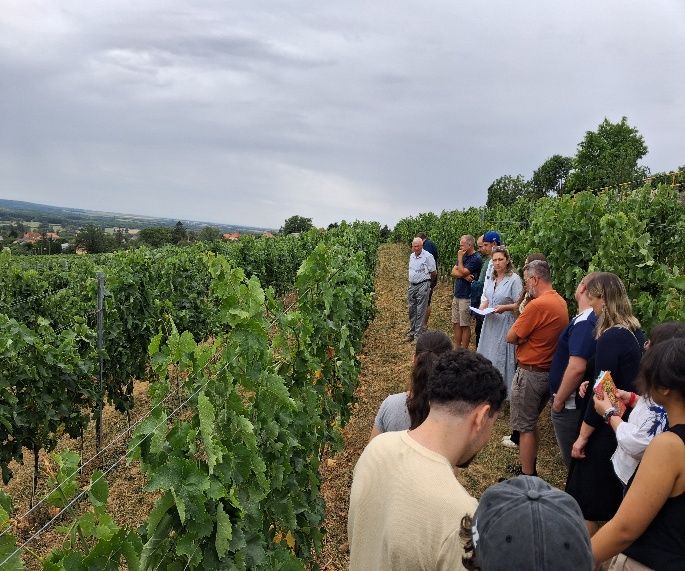
Our journey continues in Hungary, Spain and France, where field training sessions explored different dimensions of grapevine resilience, from disease-resistant varieties and Integrated Pest Management (IPM) strategies to soil health.
Organised under Work Package 5 (WP5), they aim to foster knowledge exchange and support the adoption of more sustainable vineyard practices.
🇭🇺 On 8 July, University of Pécs welcomed participants to its Hungarian demonstration farm for a presentation on disease-resistant varieties used in IPM strategies. The training also included a comparative evaluation of plant protection treatments and a comparison of IPM strategies in relation to soil health and soil biological activity, followed by a presentation of the experimental plots and a guided field tour.
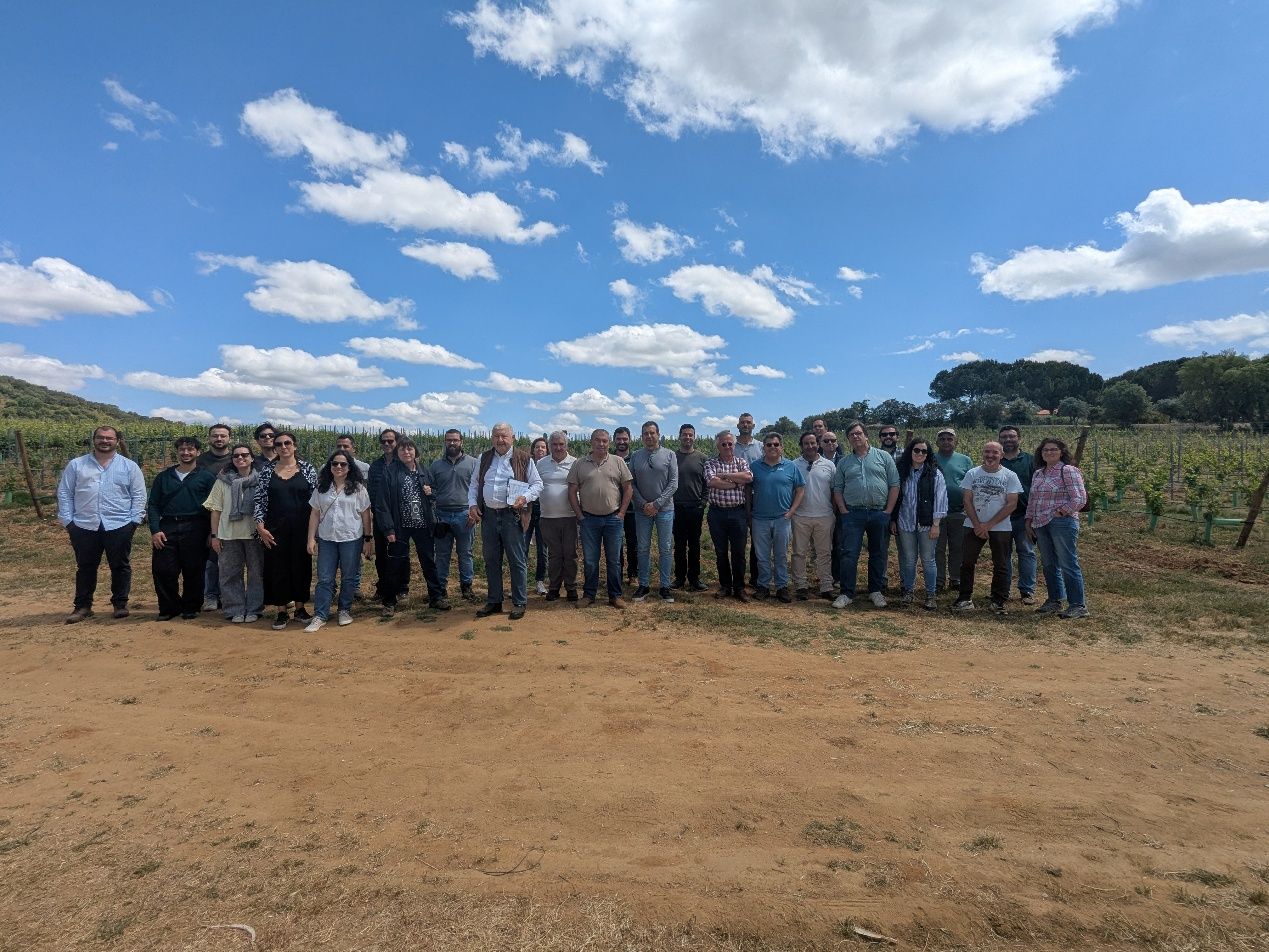
🇪🇸 On 21 July, Universidad de La Rioja organised a training session at its Spanish demonstration farm, with the involvement of the ITACyL (Instituto Tecnológico Agrario de Castilla y León). The session focused on the evaluation of PIWI varieties against downy and powdery mildew, as well as IPM strategies.
🇫🇷 On 23 July, GIP BOURGOGNE JURA VIGNE ET VIN presented the Shield4Grape project trial, conducted in partnership with Vinipôle Sud Bourgogne and UMR Agroécologie at the experimental site of the Chambre d’Agriculture de Saône et Loire in Aluze.
The trial compares IPM and biocontrol strategies applied to four disease-resistant varieties (Voltis, Floréal, Artaban, Vidoc) and two susceptible reference varieties (Aligoté, Pinot Noir). Vineyard monitoring is used to assess the effectiveness of these strategies against downy mildew, powdery mildew and black rot. Participants also tasted microvinified wines produced by Comité des vins de Bourgogne – Bourgogne Wine Board, including blends of resistant varieties with Chardonnay and Pinot Noir.
Shield4Grape project partners organised field training and demonstration activities across [...]
Are grape growers ready to adopt New Genomic Techniques (NGTs)? [...]

Shield4Grape project took part in the 2nd SIDEA-SIEA-CESET Conference in [...]
-
Shield4Grape project partners organised field training and demonstration activities across [...]
-
Are grape growers ready to adopt New Genomic Techniques (NGTs)? [...]